
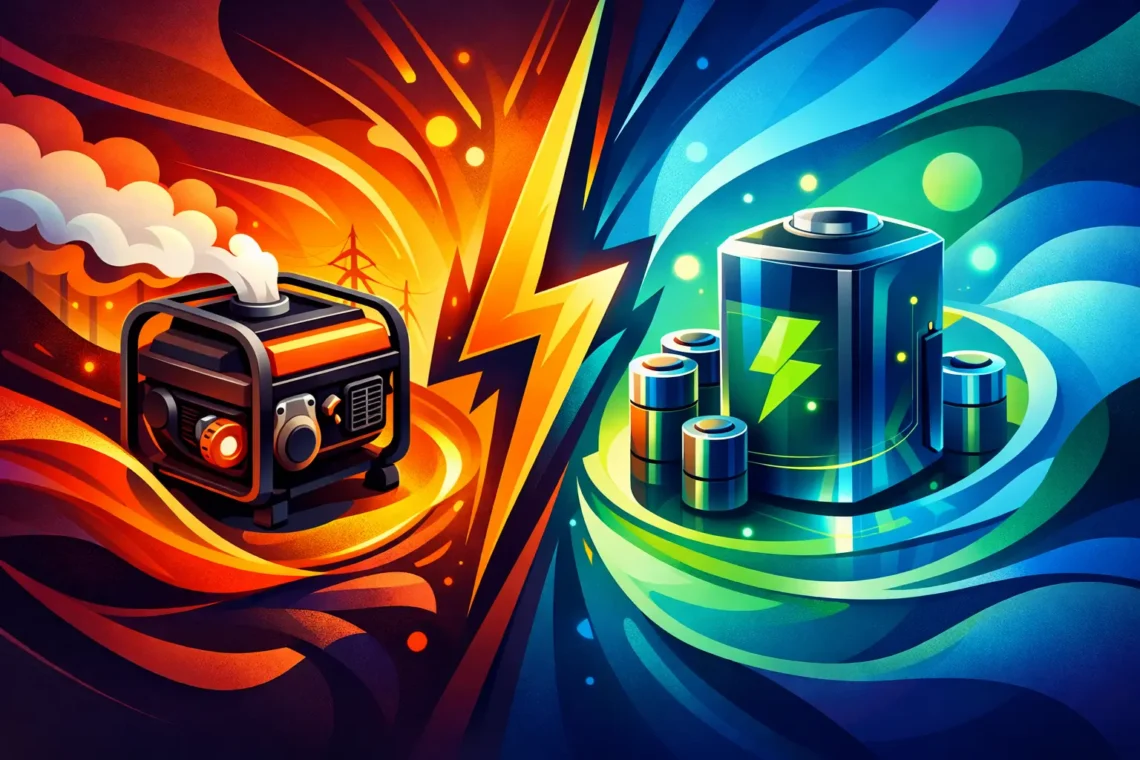
When the power drops in South Louisiana, the question gets real fast: generator or battery backup? For homeowners and business owners, this is not just about convenience. It is about keeping refrigeration, lighting, internet, security systems, medical equipment, and daily operations running when the grid does not.
The right answer depends on what you need to power, how long outages typically last, and how much electrical work your property can support. Some buildings need whole-home coverage for days. Others only need a quiet, short-term solution for a few critical circuits. A good decision starts with the real conditions on your property, not a one-size-fits-all pitch.
Generator or Battery Backup: The Core Difference
A generator creates power while it runs. A battery backup stores power ahead of time and supplies it when utility power fails. That one difference affects almost everything else, including runtime, noise, maintenance, fuel needs, installation requirements, and long-term use.
A standby generator is usually the stronger fit when you want to support large electrical loads or long outages. Central air conditioning, electric water heaters, full kitchen loads, commercial refrigeration, and multiple circuits at once can push far beyond what a typical battery system is designed to handle for extended periods.
A battery backup system is often a better fit when quiet operation matters, outages are shorter, or the goal is to keep only essential loads energized. Think lighting, routers, computers, a few outlets, security equipment, and selected appliances. In the right setup, it can be a clean and practical solution. But it has limits, and those limits matter.
When a Generator Makes More Sense
If your property regularly experiences multi-hour or multi-day outages, a generator usually gives you more dependable coverage. Standby generators connected to natural gas or propane can keep running as long as the fuel source is available. That makes them especially attractive for families with medical equipment, homes with sump or lift pumps, and businesses that cannot afford a long interruption.
Load size is another big factor. Many people say they want backup power, but what they really mean is they want the house or building to work almost normally. That includes air conditioning, kitchen appliances, lighting, and sometimes shop equipment or office systems. A generator is generally the more realistic path if you expect that level of performance.
There is also the automatic transfer advantage. A properly installed standby generator can detect an outage, start automatically, and transfer power without the owner dragging out extension cords or managing a portable unit in bad weather. That convenience is not just about comfort. It also supports safety and continuity.
The trade-off is that generators are mechanical systems. They require maintenance, fuel planning, proper ventilation, and code-compliant installation. They also make noise. For some properties, that is a small downside. For others, especially in tighter residential settings, it may matter more.
When Battery Backup Is the Better Fit
Battery backup appeals to customers who want cleaner, quieter backup power for essential circuits. It is especially useful when the main goal is to bridge short outages, avoid work disruption, or protect electronics and low-draw equipment from sudden shutdowns.
For some homes, that can mean keeping internet service, a refrigerator, a few lights, phone chargers, and security cameras online. For small offices, it may mean supporting networking equipment, point-of-sale systems, workstations, and communication devices long enough to avoid immediate disruption.
The biggest advantage is quiet operation. There is no engine noise, no exhaust, and no fuel storage. Maintenance is usually lower than with a generator, and the system can feel more hands-off day to day. In some applications, batteries also pair well with energy management goals.
The biggest limitation is capacity. The more you try to run, and the longer you try to run it, the larger and more expensive the battery system becomes. Air conditioning, electric heat, dryers, ovens, and other heavy loads can drain stored power quickly. If your outage lasts longer than expected, battery runtime becomes the deciding issue.
Cost Depends on More Than Equipment
People often compare price tags first, but installed cost is really about the whole system. With either option, the electrical side matters. Load calculations, panel condition, transfer equipment, dedicated circuits, permitting, and code compliance all affect the final scope.
A generator may require a concrete pad, gas coordination, transfer switch installation, and panel work. A battery backup may require inverter equipment, load management planning, subpanel configuration, and enough storage capacity to support realistic runtime goals. If your existing electrical panel is outdated or undersized, that can change the project in a hurry.
This is why the cheapest advertised unit is rarely the right benchmark. A backup power system should be sized around your actual needs and installed to perform safely when the utility power fails. Cutting corners on the electrical design usually shows up at the worst possible time.
What to Consider Before You Choose
The first question is simple: what absolutely needs to stay on? Not what would be nice to have, but what must keep working. For one customer, that is a refrigerator, lights, and internet. For another, it is full HVAC, elevators, office systems, and security infrastructure.
The second question is duration. If outages in your area are usually brief, battery backup may cover the problem well. If storms regularly leave neighborhoods without power for long stretches, generator capacity starts to look a lot more practical.
The third question is property type. A single-family home, a mixed-use building, a retail storefront, and a warehouse all use power differently. Commercial clients often have additional considerations such as access control, emergency lighting, network rooms, tenant expectations, and equipment sensitivity.
The fourth question is existing electrical infrastructure. Your panel, service size, wiring layout, and available space can all affect what makes sense. Sometimes the right move is not just adding backup power. It is upgrading the panel or reorganizing circuits so the backup system can work efficiently and safely.
Generator or Battery Backup for Homes
For residential properties, the best choice usually comes down to lifestyle and outage tolerance. If your household wants the freedom to keep the home operating with minimal interruption, a standby generator is often the better fit. That is especially true if you rely on central AC during hot, humid weather or need backup for medical, refrigeration, or pump loads.
Battery backup can still make sense in a home, but the expectations need to be clear. It works best when the homeowner is comfortable prioritizing a smaller set of essential loads. If the goal is quiet backup for shorter interruptions, it can be a strong option.
In many cases, the decision is less about which technology is better overall and more about which one fits the way you actually live. That is why real load planning matters.
Generator or Battery Backup for Businesses
Commercial properties usually feel the cost of downtime faster. Lost transactions, interrupted communications, security gaps, and equipment shutdowns can create problems long before the lights become the main issue.
For that reason, generators often make more sense for businesses with larger loads or higher continuity demands. Restaurants, retail operations, offices with network infrastructure, and properties with refrigeration or security requirements typically need more than a short bridge of power.
Battery systems can still be useful in commercial spaces, especially for targeted protection of sensitive electronics, communication systems, and specific low-draw circuits. But for broad operational continuity, they are often part of a narrower strategy unless the system is built at a much larger scale.
Professional Installation Matters
Backup power is not a plug-and-play category when you are protecting a home or business. Whether you choose a generator or battery backup, safe installation requires correct sizing, code-compliant wiring, transfer equipment, and a clear understanding of what your building is asking the system to do.
That is where working with an experienced electrical contractor matters. A qualified team can evaluate your panel, identify critical loads, explain trade-offs clearly, and install a system that performs the way you expect when the grid goes down. For customers in Greater New Orleans, Wiring Resource approaches these projects with the same focus that applies to every electrical job: safety, quality workmanship, and clear communication from estimate to final installation.
The best backup power system is the one that matches your property, your budget, and your tolerance for downtime. If you start with those three things, the right choice gets a lot clearer.